
Sweet chestnut and horse chestnut share a name, but the Woodland Trust points out that the two trees are not related: horse chestnut belongs to the soapberry family, sweet chestnut to the beech family. Poison Control (National Capital Poison Center, USA) says all parts of the horse chestnut tree are toxic and that its seeds can easily be mistaken for what it calls edible chestnuts. This guide covers how to tell them apart, when they fall, where they grow, the buckeye name and the North American chinkapin, the law on picking, and what to do if someone has eaten a horse chestnut.
The Woodland Trust says the leaves are completely different: sweet chestnut (Castanea sativa) has single, long, serrated leaves, while horse chestnut (Aesculus hippocastanum) has hand shaped leaves with deeply divided lobes or fingers.
Both seeds grow in green shells, but horse chestnut cases are covered in short spikes, while sweet chestnut cases have lots of fine spines. Poison Control describes the pod of edible chestnuts as spiky and furry looking, and says the spikes on horse chestnut pods are spaced more widely apart.
Inside the shells, sweet chestnuts contain two or three teardrop shaped nuts, while the round, glossy conkers of the horse chestnut are usually single. According to Poison Control, the nuts of edible chestnuts have a pointed end or tassel. Horse chestnuts are completely round and leathery with a pale or white spot, and they are very bitter, but Poison Control asks you not to taste them to find out.
Sweet chestnut is a deciduous tree that can reach 35 m when mature and live for up to 700 years. Its bark is grey purple and smooth and develops vertical fissures with age. In winter it can be identified by bark fissures that spiral upwards around the tree. First Nature adds that the bark of a young tree has no obvious distinguishing features until the tree is at least twenty years old.
The leaves are about 16 to 28 cm long and 5 to 9 cm wide, oblong with a pointed tip and a serrated or toothed edge. They are quite glossy, with about 20 pairs of prominent parallel veins, and the Woodland Trust suggests looking out for widely spaced teeth around the edges.
The flowers are long, yellow catkins of mostly male flowers, with female flowers at the base. After pollination by insects, the female flowers develop into shiny, red brown fruits wrapped in a green, spiky case. The trees begin to bear fruit when they are around 25 years old.
Mature horse chestnut trees grow to a height of around 40 m and can live for up to 300 years. Its bark is smooth and pinky grey when young, and later darkens and develops scaly plates. The buds are oval, dark red, shiny and sticky, and in winter the tree can be identified by its large, sticky red buds.
The palmate leaves consist of five to seven pointed, toothed leaflets spreading from a central stem. When the leaf stalks fall, they leave a scar on the twig that resembles an inverted horseshoe with nail holes.
The flowers appear in May and have four to five fringed petals, white with a pink flush at the base. Each pollinated flower develops into a glossy, red brown conker inside a spiky green husk, which falls in autumn.
Poison Control says all parts of the horse chestnut tree are toxic, and that the greatest concern is the seeds. It names the toxin as saponin aesculin and says it is not absorbed very well, so eating horse chestnuts tends to cause mild to moderate symptoms, most commonly stomach irritation. Its summary adds that eating horse chestnuts can result in serious stomach upset.
It says there have been reports of children who felt weak, had difficulty walking, became drowsy, and experienced paralysis and muscle twitching, in addition to major stomach irritation. It also cites reports of severe symptoms in adults: over a 29 year period in Switzerland, three cases of horse chestnut poisoning led to severe symptoms within 15 to 30 minutes of swallowing one to four seeds, including redness, facial swelling, massive vomiting, low blood pressure and collapse. One patient developed angioedema, a swelling of the lower face that blocked the airway.
Symptoms most often develop 15 minutes to 3 hours after eating a horse chestnut and can last 2 to 3 days. In one case described by Poison Control, a man who had boiled and eaten four horse chestnuts had an upset stomach, and his symptoms lasted 4 hours.
In Germany, a 2017 consumer brochure from the Federal Institute for Risk Assessment (BfR) on poisoning accidents in children lists horse chestnut fruits among slightly poisonous plants, for which mild symptoms such as vomiting, abdominal pain or diarrhoea are to be expected after larger amounts.
Poison Control advises not to let children and pets eat the contents of fallen seed pods.
In the UK, the Woodland Trust says sweet chestnut trees start dropping nuts from October and continue into late autumn and early winter. It says the best crop is found at the foot of large, established trees.
First Nature says the nuts, protected inside spiny bracts, ripen in late autumn and are at their best in December.
In the UK, the Woodland Trust says horse chestnut conkers ripen in autumn and usually fall to the ground in September and October, although this can happen earlier if the summer has been hot and dry.
Sweet chestnut is native to southern Europe, western Asia and North Africa. In the UK it is found commonly in woods and copses, especially in parts of southern England where it is still managed as coppice.
Horse chestnut is native to the Balkan Peninsula and was first introduced to the UK from Turkey in the late 16th century. It is rarely found in woodland, but it is a common sight in parks, gardens, streets and on village greens.
Sweet chestnut is susceptible to fungal diseases, and chestnut blight, which causes bark cankers and can lead to dieback and death, has recently arrived in the UK.
Poison Control says horse chestnuts are sometimes called buckeyes because of the pale spot on the nut.
In North America, the chinkapin (Castanea pumila) is a small tree or large shrub of 2 to 5 m in the beech family, native to the eastern and southern United States. Its fruit is a spiny bur that houses a single nut, and the fruits mature in autumn and winter.
In Germany, the Federal Nature Conservation Act lets anyone carefully take wild fruits from nature in small quantities for personal use, at places that are not subject to an access ban.
In England and Wales, the Theft Act 1968 says that a person who picks fruit or foliage from a plant growing wild does not steal what they pick, unless they do it for reward, for sale or for another commercial purpose. For this rule, plant includes any shrub or tree.
Rules elsewhere, and rules for nature reserves or private land, are not covered here, so check the law where you are.
The NHS website says to call 999 or go to A&E if you think someone may have swallowed something harmful, and to call NHS 111 if you are not sure whether it is harmful. It advises not to try to make someone sick and not to give the person anything to eat or drink.
In the US, Poison Control says to call 911 immediately if the person collapses, has a seizure, has trouble breathing or cannot be woken. If someone has unintentionally eaten part of a horse chestnut, Poison Control advises gently wiping out their mouth, having them rinse with water and spit, and then giving a few small sips of water. If they feel sick or vomit, it advises keeping them hydrated with small sips of clear fluids. Poison Control says to call 1 800 222 1222 and not to wait for symptoms to develop.
For Germany, the BfR brochure says to call the emergency number 112 straight away if breathing is disturbed or obstructed or in case of a seizure. The BfR advises removing all plant remains from the mouth straight away and keeping them for the doctor, then calling a poison centre or seeing a doctor or hospital. The BfR says the important information is which plant it was, which parts were eaten, how much and how long ago; for children, age and weight also matter. As a first measure, the BfR says one or two glasses of water or tea can be drunk, but advises against milk or salt water and against inducing vomiting. It says further measures are not advisable without first getting medical advice. The BfR brochure asks readers to follow the advice of their poison centre.
The BVL lists poison centres in Germany and Austria, for example Giftnotruf Berlin on 030 192 40 and the Austrian centre on +43 140 643 43. Tox Info Suisse runs the Swiss emergency number 145. In case of unconsciousness or respiratory and circulatory arrest, Tox Info Suisse says to alert the ambulance service on 144, or 112 within the EU.

Hand shaped leaves with five to seven leaflets, a husk with short spikes and usually a single round, glossy seed. Poison Control says all parts of the tree are toxic.
Photos are for orientation only: a photo alone is not enough to identify a species.
Poison Control warns that horse chestnut seeds can easily be mistaken for edible chestnuts and that all parts of the tree are toxic. It advises never to eat an unknown plant or seed without verification from a clear field guide or someone with experience. The BfR advises foragers, when in doubt, not to eat plants they have collected themselves. The NHS website says to call 999 or go to A&E if someone may have swallowed something harmful. In the US, Poison Control says to call 911 immediately if the person collapses, has a seizure, has trouble breathing or cannot be woken, and to call a poison center on 1 800 222 1222 for expert guidance. In Germany, for example, Giftnotruf Berlin is on 030 192 40, and in Austria the poison centre is on +43 140 643 43. In Germany, call 112 straight away if breathing is disturbed or in case of a seizure. In Switzerland Tox Info Suisse is on 145, and for unconsciousness or respiratory arrest the ambulance service is on 144.
Sweet chestnut has single, long, serrated leaves, horse chestnut hand shaped leaves with deeply divided lobes. Sweet chestnut cases have lots of fine spines and hold two or three teardrop shaped nuts, while horse chestnut cases have short spikes and usually hold a single round, glossy conker.
Poison Control says all parts of the horse chestnut tree are toxic and that the seeds are the greatest concern. It also cites some reports of severe symptoms in adults, including a swelling of the lower face that blocked the airway. A BfR brochure on poisoning in children lists horse chestnut fruits among slightly poisonous plants, for which mild symptoms such as vomiting, abdominal pain or diarrhoea are expected after larger amounts.
In the UK, the Woodland Trust says the trees start dropping nuts from October and continue into late autumn and early winter. First Nature says the nuts are at their best in December.
Poison Control says horse chestnuts are sometimes called buckeyes because of the pale spot on the nut. It says the toxin aesculin makes all parts of the horse chestnut tree poisonous.
In Germany, anyone may carefully take wild fruits from nature in small quantities for personal use at places without an access ban. In England and Wales, picking fruit from a plant growing wild is not theft unless it is done for reward, sale or another commercial purpose. Nature reserves, private land and other countries are not covered here.
Forage shows you the species in your region and pings you when the season starts.


All information without guarantee. This text is orientation on season and habitat, not an identification guide, and it makes no claim about whether any specific plant or mushroom is edible. Many species have toxic, some deadly, lookalikes. Never eat or use anything that has not been identified with certainty by an expert, such as a qualified mushroom inspector. We accept no liability for any harm arising from the use of this information. If you suspect poisoning, call your local poison control center or emergency services right away. Mind conservation law and property rights.
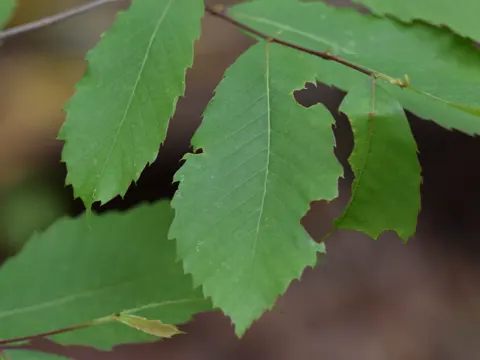 ChinkapinCastanea pumila