
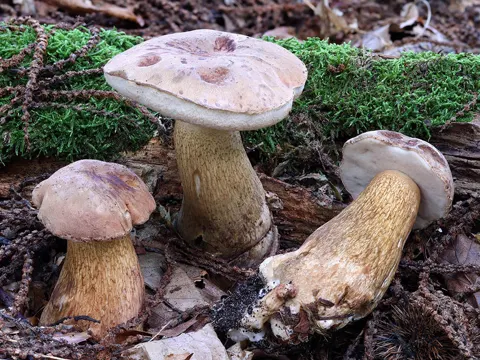
Porcini is one of several names for Boletus edulis, along with penny bun, cep and king bolete. It has a brown cap, tubes ending in very small white or yellowish pores, and a thick stem with a faint white net pattern. Forage gives a typical window of July to November in the northern hemisphere, with a peak from July to October. First Nature says it is well worth learning to tell the bitter bolete apart, and its pale pores turn coral pink as it matures. The German Mycological Society (DGfM) says to collect only species you know with certainty.
First Nature describes the cap as yellow brown to reddish brown with a slightly greasy, bun like surface, and the margin is usually lighter than the rest of the cap. It gives a cap size of 10 to 30 cm at maturity. The Woodland Trust gives 8 to 25 cm across. Wild Food UK gives 7 to 12 cm and says caps are white when very young.
Under the cap are tubes that end in very small white or yellowish pores. When cut or bruised, the pores and tubes do not change colour, and cut cap flesh stays white with no hint of blue. As the mushroom matures, the pore surface becomes greenish yellow.
The stem is club shaped or barrel shaped, 10 to 20 cm tall and up to 10 cm thick. A faint white net pattern on a cream background is most noticeable near the top. The smell is faint but pleasant.
In North America, whether the true Boletus edulis occurs at all is debated, and MushroomExpert keys out 14 similar species there. Poison Control warns that learning to identify mushrooms in one area or country is not reliable for identifying them in another.
Forage gives a typical northern hemisphere window of July to November, with a peak from July to October, and says your own timing depends on local weather. First Nature gives June to October for Britain and Ireland. Wild Food UK says they are generally seen around late summer to the start of autumn.
Some similar North American boletes keep different hours. In the mountains of California and the Pacific Northwest, Boletus rex-veris appears in spring, adjusted for elevation, and Boletus edulis var. grandedulis appears in fall and winter under pines in coastal California.
Rain matters for the timing. Wild Food UK says porcini are generally seen eight days after rain. First Nature finds young, fresh fruitbodies often at their best a few days after summer rain, and says that a week to ten days later more of them are likely to contain maggots.
Porcini grow on soil beneath trees, notably beech and birch, and less commonly oaks, pines, spruces and occasionally other conifers. They form a partnership with tree roots, so First Nature says they do not occur in open grassland. Tree roots reach a long way, so a porcini can come up some tens of metres from the trunk of its partner tree.
The Woodland Trust says the species prefers open ground in woodland, particularly wood edges and grassy clearings. First Nature also finds it frequently at the edges of clearings in broadleaved and coniferous forests.
The summer bolete (Boletus reticulatus) grows with beech and less often oaks, and fruits a little earlier than porcini. It lacks the broad pale band around the cap rim, and a net pattern usually runs well down its stem.
The pine bolete (Boletus pinophilus) has a wine coloured to reddish brown cap and grows in conifer forests and plantations. The bronze bolete (Boletus aereus) has a dark brown cap and grows beneath broadleaf trees, notably beech and oaks. It tends to fruit a little later than porcini.
First Nature calls the bitter bolete (Tylopilus felleus) a look-alike of porcini that is sometimes mistaken for it because of its netted stem. Its pores start pale and turn coral pink as it matures, and they gradually turn brown when bruised. Wild Food UK separates the stems like this: the bitter bolete has a dark net on a lighter background, while porcini has a light net on a slightly darker background. First Nature calls it inedible and very bitter indeed, and says cooking only seems to enhance the bitter taste. The DGfM says not to eat raw mushrooms.
The Woodland Trust also warns not to confuse penny bun with the devil's bolete. The DGfM lists the devil's bolete (Rubroboletus satanas) under gastrointestinal poisoning. First Nature calls it rather rare in Britain and Ireland, but more common in parts of southern Europe. Its cap is chalky white at first, its stem has a red net that goes all red towards the base, and its pores are yellowish in very young fruitbodies but soon turn orange and then red. First Nature advises leaving all red pored boletes off the menu.
The bitter beech bolete (Caloboletus calopus), which First Nature says could be confused with the devil's bolete, has a smoky grey cap and yellow pores that turn blue green when cut or bruised. Its stem is lemon yellow at the top and flushed red below. The DGfM lists it, together with the devil's bolete, under gastrointestinal poisoning.
The bay bolete (Imleria badia) is also mentioned by the Woodland Trust as similar looking. Its stem is neither smooth nor netted but lined with shallow brown ridges, and its pale yellow pores nearly always turn blue green when bruised.
First Nature names avoiding boletes with red or pink pores as its condition for a passable meal. Yellow pores do not settle it: First Nature describes the bitter beech bolete with yellow pores that turn blue green when cut or bruised. Poison Control says never to pick and eat wild mushrooms unless an expert has identified them. The DGfM says not to rely on self-appointed mushroom experts or apps, and to go to a certified mushroom expert instead. DGfM experts do not clear mushrooms they have not been shown in person, and identification from a distance is forbidden for them. Always show complete fruitbodies. It adds that no method, recipe or object can establish whether a mushroom is poisonous.
The DGfM recommends taking mushrooms carefully out of the ground, because the stem base often carries important identifying features. Whether you cut or twist makes no difference to the mycelium. Clean them roughly before they go in the basket, and keep unknown mushrooms separate, because even small parts of a deadly poisonous mushroom can spoil the whole basket.
Use a basket and not a plastic bag, where mushrooms sweat and break down very easily. The DGfM advises leaving mushrooms that are too old, maggoty or mouldy, as well as very young ones, where they are. Most mushroom poisonings, the DGfM says, are caused by eating overaged specimens of edible species. It also warns that mushrooms from road and field edges or industrial land can be contaminated with fertiliser, pesticides or heavy metals.
In Germany, the DGfM says porcini are protected. The Federal Species Protection Ordinance exempts them when taken in small quantities for your own needs. The DGfM gives a guide figure of about 1 to 2 kg per collector per day.
The DGfM advises against eating raw mushrooms and says to heat them for at least 15 minutes at 70 degrees Celsius. Even long cooking does not destroy all mushroom toxins. Keep them in the fridge for only a few days, and avoid excessive portions.
First Nature dries its porcini by cutting them into thin slices and placing them on a warm radiator or in a warm oven with the door open. Wild Food UK notes that tests on dried penny buns found many different boletes in a packet, because they are hard to identify visually once dried.
The gastrointestinal syndrome that the DGfM lists for the devil's bolete and the bitter beech bolete causes nausea, vomiting and diarrhoea, with a latency of 15 minutes to 4 hours. A short delay does not rule out a serious poisoning from a species with a long delay. Symptoms can also appear hours and in rare cases days after the meal.
The DGfM says to take people with severe symptoms to hospital and call 112 if needed, and to contact a poison centre in the case of mild symptoms or worry. Its advice also covers the case where you are no longer sure about mushrooms you have already eaten, and everyone who shared the meal must be informed. Keep leftovers, cleaning scraps or vomit for the doctors, and do not lose time searching online or using apps. Do not induce vomiting, and give nothing to eat or drink without medical instruction.
The BVL lists poison centres in Germany and Austria, for example Giftnotruf Berlin on 030 192 40 and the Austrian centre on +43 140 643 43. Tox Info Suisse runs the Swiss number 145. In the UK, the NHS says to call 999 or go to A&E if you think someone may have swallowed something harmful, and to call 111 if you are not sure. Do not drive yourself: ask someone to drive you or call 999. In the US, Poison Control says to call a poison centre right away on 1-800-222-1222 if someone has eaten a wild mushroom.
To find a certified mushroom expert in Germany, use the DGfM directory.
For the method behind identifying mushrooms, read the guide to identifying mushrooms. To see which species are in season near you, use the Season Finder. Both are linked below.
Pores turn coral pink with age. Dark net on a lighter stem background. Very bitter, and cooking only seems to enhance it.
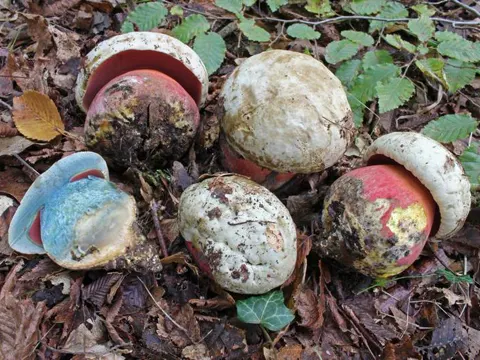
Listed by the DGfM under gastrointestinal poisoning. Chalky white cap, red net on the stem, pores soon turning orange and then red.

Stem lined with shallow ridges and no net, pale yellow pores that nearly always turn blue green when bruised.
Photos are for orientation only: a photo alone is not enough to identify a species.
Check pores, stem net and colour change, avoid boletes with red or pink pores, and show anything you are not certain of to a certified mushroom expert in person. If someone may have eaten a poisonous mushroom, get help even without symptoms: emergency services for severe symptoms, otherwise a poison centre. In the UK, call 999 or go to A&E, or call NHS 111 if you are not sure it was harmful.
Porcini is one of the names for Boletus edulis, also known as penny bun, cep and king bolete. The Woodland Trust explains that porcini means little pigs in Italy, and Germans call it Steinpilz, or stone mushroom.
Forage gives a typical window of July to November in the northern hemisphere, with a peak from July to October. First Nature gives June to October for Britain and Ireland.
On soil beneath trees, notably beech and birch, and less commonly oaks, pines, spruces and occasionally other conifers. The Woodland Trust names wood edges and grassy clearings in particular.
The bitter bolete has pores that turn coral pink with age. Its stem has a dark net on a lighter background, while porcini has a light net on a slightly darker background.
First Nature says the pores and tubes do not change colour when cut or bruised, and that cut cap flesh stays white with no hint of blue.
Under the Federal Species Protection Ordinance, yes, in small quantities for your own needs: it exempts Boletus edulis on those terms. The DGfM gives a guide figure of about 1 to 2 kg per collector per day.
Forage shows you the species in your region and pings you when the season starts.


All information without guarantee. This text is orientation on season and habitat, not an identification guide, and it makes no claim about whether any specific plant or mushroom is edible. Many species have toxic, some deadly, lookalikes. Never eat or use anything that has not been identified with certainty by an expert, such as a qualified mushroom inspector. We accept no liability for any harm arising from the use of this information. If you suspect poisoning, call your local poison control center or emergency services right away. Mind conservation law and property rights.
 Summer boleteBoletus reticulatus