☠ deadly
Most fatal mushroom poisonings in Central Europe are caused by the death cap (Amanita phalloides), according to the German Mycological Society (DGfM). Eating as little as 50 grams of one fruitbody can be fatal. The DGfM also says there is no method, recipe or object that can tell you whether a mushroom is poisonous. This guide covers the most dangerous species, the mushrooms they are mistaken for and what to do in an emergency.
The DGfM is clear: no methods, recipes, objects, plants such as garlic or metals such as a silver spoon show whether a mushroom is poisonous. Mushrooms that animals have nibbled can still be poisonous to people. Even a long cooking time does not destroy all mushroom toxins.
The DGfM advises against relying on self appointed mushroom experts or apps and recommends a certified mushroom expert instead. It also warns that a short delay before the first symptoms does not rule out a severe poisoning by a species whose symptoms come late.
The DGfM describes a cap up to 12 cm across, more or less green and often fading towards the edge. The free gills and the spore print are whitish. A fleeting white ring hangs on the stem, and the bulbous base sits in a lobed, open sheath, the volva. First Nature notes an all white form that looks very similar to the destroying angel.
According to the DGfM, the death cap is most often mistaken for field mushrooms (Agaricus) or green brittlegills (Russula). Because the base can be hidden in the leaf litter, the DGfM advises levering unknown gilled mushrooms out of the ground instead of cutting them off. First Nature adds that Agaricus mushrooms have no volva, and that young death caps lack the grey or pinky brown gills of young Agaricus. At the button stage, death caps can be mistaken for puffballs, but cut lengthwise the volva shows at once.
The DGfM gives July to October as its fruiting time, especially in dry, warm summers after heavy rain.
The DGfM lists the death cap, two further Amanita species (Amanita verna and A. virosa), the funeral bell (Galerina marginata) and several small dapperlings (Lepiota) as causes of the amatoxin syndrome. It starts with violent vomiting and diarrhoea, followed by an apparent improvement while liver damage begins, up to liver failure, blood clotting disorders and kidney failure.
The delay is usually 8 to 12 hours, within a range of 4 to 36 hours. The amatoxins are heat stable and survive cooking. For death cap poisoning, the DGfM says that untreated or treated too late, death follows between the 3rd and the 10th day.
The DGfM lists the destroying angel among the causes of the amatoxin syndrome. The cap is 5 to 10 cm across, pure white and without striations at the margin. The stem is 9 to 15 cm tall and pure white with a fragile ring, and the large, sack like volva is usually buried deep in the soil.
In Britain and Ireland it is infrequent in the lowlands and more plentiful in mountainous areas. In northern Europe it usually appears in July, August and September. First Nature warns that young destroying angels can be confused with Agaricus mushrooms and buttons with puffballs.
The DGfM names the fool's webcap (Cortinarius orellanus) and the deadly webcap (C. rubellus) as causes of the orellanus syndrome. Symptoms include thirst, headache, a dry mouth, kidney pain, failing urine production and acute kidney failure, as a rule without stomach or bowel symptoms. They can take days to start, up to 3 weeks. The DGfM regards all webcaps with yellow, orange, green and red pigments as suspected poisonous.
Despite its very different shape, the orange cap of the deadly webcap has led to it being mistaken for chanterelles. Its tawny brown to orange cap is 4 to 8 cm across, the gills turn rusty brown as the spores mature, and the stem usually bears a yellowish, snakeskin like pattern. It grows with conifers, pine and spruce in particular, on damp acid soil.
The fool's webcap is rather more common in southern Europe and grows with hardwoods, especially oak, and sometimes under conifers.
The DGfM lists the funeral bell among the causes of the amatoxin syndrome. It grows on stumps, dead trunks and fallen branches of conifers and sometimes broadleaf trees. Its caps are 1 to 7 cm across. First Nature says it looks very similar to the wood tuft (Kuehneromyces mutabilis), which some people gather for food.
The DGfM also lists the deadly dapperling (Lepiota brunneoincarnata) among the causes of the amatoxin syndrome. It regards small dapperlings with brownish and red pigments as suspected of containing amatoxins.
The DGfM lists the false morel under the gyromitrin syndrome: violent vomiting and diarrhoea plus damage to the central nervous system, the liver and the kidneys. Symptoms start after 6 to 24 hours, within a range of 2 to 25 hours. The DGfM cites the WHO advice that false morels should be avoided in general.
First Nature says the false morel is sometimes collected by mistake by people looking for morels. Its red brown cap is irregularly lobed like a brain, while the true morel has a deeply pitted cap and a single hollow chamber.
The DGfM links the muscarine syndrome to the deadly fibrecap (Inocybe erubescens), many other fibrecaps and several funnels (Clitocybe) such as C. rivulosa. Symptoms are sweating, salivation, watering eyes, a slow pulse, narrow pupils, vision problems and sudden violent vomiting and diarrhoea. They start 15 minutes to 2 hours after the meal.
First Nature says the deadly fibrecap grows in habitats where people expect to find mushrooms to eat. Its cap surface and gills redden when bruised. The fool's funnel (Clitocybe rivulosa) often grows in fairy rings, so anyone gathering fairy ring champignons or St George's mushrooms must identify every single specimen with complete certainty.
The DGfM lists the panthercap (Amanita pantherina) and the fly agaric (A. muscaria) under the pantherina syndrome, with symptoms such as wide pupils, a fast pulse, hallucinations, seizures and coma. Symptoms start 15 minutes to 4 hours after eating.
First Nature says the veil fragments on the panthercap are pure white, while those of Amanita excelsa are grey. The white spots can be missing, especially in wet weather.
The DGfM lists the livid pinkgill (Entoloma sinuatum) under the gastrointestinal syndrome, with nausea, vomiting and diarrhoea. First Nature says its pale appearance means inexperienced collectors can confuse it with Agaricus mushrooms, the miller (Clitopilus prunulus) or St George's mushroom.
The DGfM describes the Paxillus syndrome caused by the brown rollrim (Paxillus involutus): it appears after repeated meals, destroys red blood cells and can lead to acute kidney failure after 1 to 2 days.
The common ink cap (Coprinopsis atramentaria) causes symptoms only together with alcohol, up to 3 days before or after the meal. Old, spoiled or mouldy mushrooms cause food poisoning rather than a classic mushroom poisoning, the DGfM explains.
The DGfM advice: with severe symptoms, go to hospital and call the emergency services on 112 if needed; with mild symptoms or if you are worried, contact a poison centre. Keep any leftovers, peelings or vomit and give them to the paramedics or the doctor; photos of the collected mushrooms also help. Do not lose time researching the cause yourself, for example by googling or using mushroom apps. Tell everyone who shared the meal. Without medical instructions, give the person nothing to eat or drink, and do not induce vomiting or give milk or salt water.
The NHS says symptoms may take a few hours or days to start, so it is important to get medical advice quickly. In the UK, the NHS says to call 999 or go to A&E if you think someone may have swallowed something harmful, and to call NHS 111 if you are not sure whether it is harmful. In the US, the poison center number is 1 800 222 1222. If the person collapses, has a seizure, has trouble breathing or cannot be woken, Poison Control says to call 911.
The BVL lists the poison centres in Germany and Austria, for example Berlin on 030 192 40 and Mainz on 06131 192 40, and the Austrian line on +43 140 643 43. In Switzerland, Tox Info Suisse runs the emergency number 145.
Mushroom experts certified by the DGfM (Pilzsachverständige) can identify the mushrooms shown to them and assess whether they are fit to eat. The DGfM shows experts near you on a map. At the slightest doubt, the DGfM advises skipping the meal.
Keep the whole fruitbody, including the base, and have every find checked before anything goes into the pan. If in doubt, leave it.
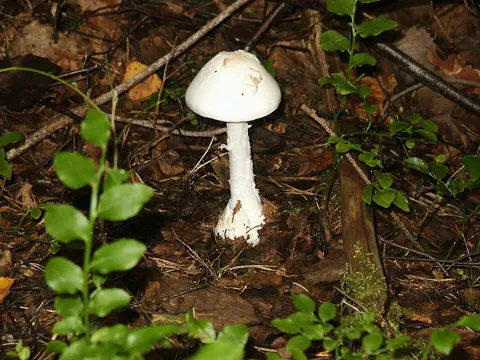 Destroying angelAmanita virosa☠ deadly
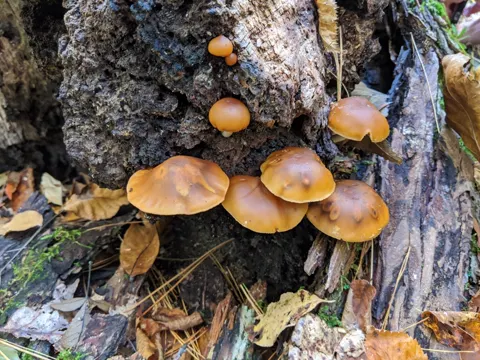 Funeral bellGalerina marginata☠ deadly
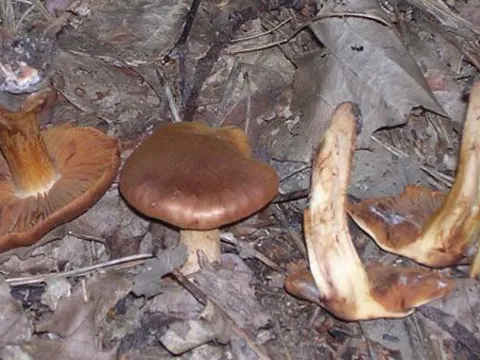 Fool's webcapCortinarius orellanus☠ deadly
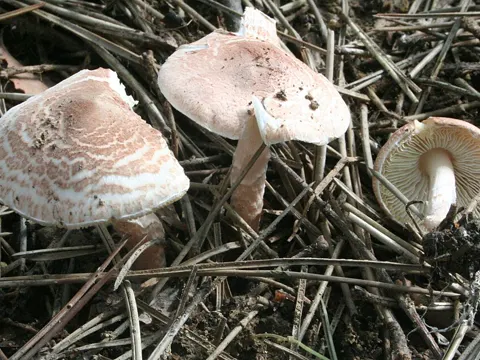 Deadly dapperlingLepiota brunneoincarnata☠ deadly
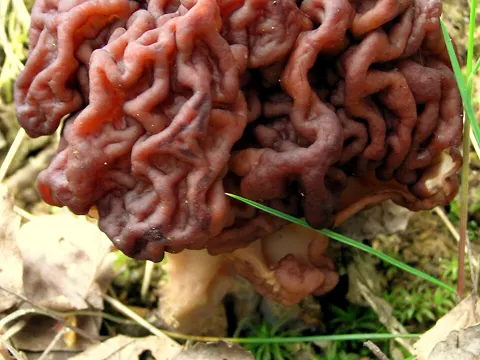 False morelGyromitra esculenta☠ deadly
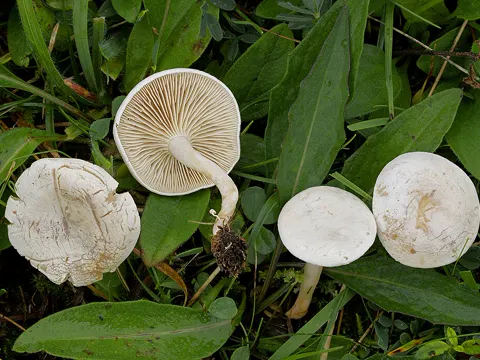 Fool's funnelClitocybe rivulosa☠ toxic
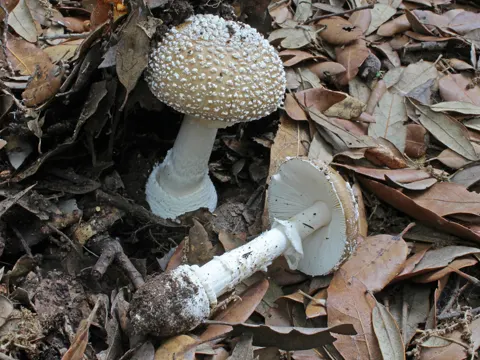 PanthercapAmanita pantherina☠ deadly
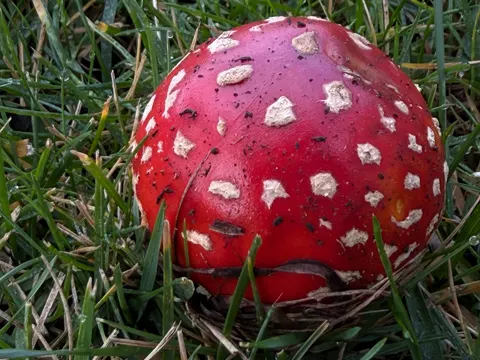 Fly agaricAmanita muscaria☠ deadly
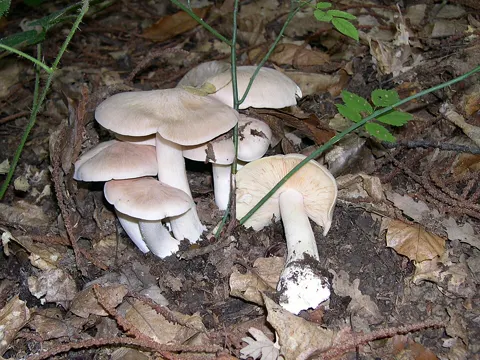 Livid pinkgillEntoloma sinuatum☠ toxic
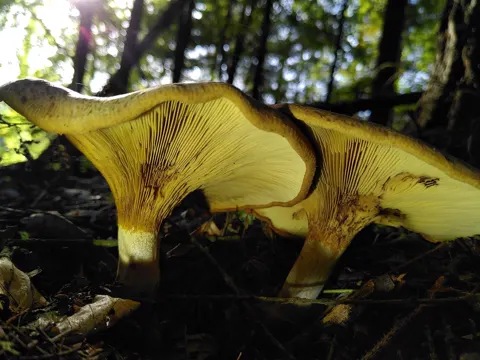 Brown rollrimPaxillus involutus☠ deadly
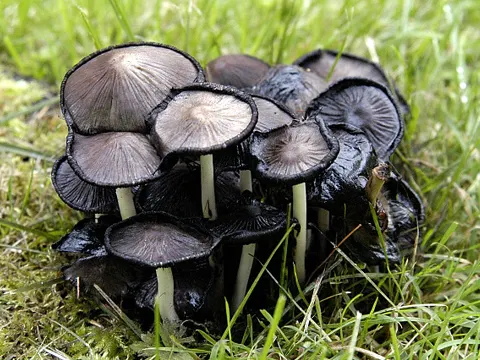 Common ink capCoprinopsis atramentaria☠ toxic
Photos are for orientation only: a photo alone is not enough to identify a species.
Never eat a wild mushroom that a certified mushroom expert has not checked, keep the whole fruitbody including the base, and if in doubt, leave it.
In Central Europe, most fatal mushroom poisonings are caused by the death cap, the DGfM says. Eating 50 grams of one fruitbody can already be fatal.
No. The DGfM says no methods, recipes, objects, plants such as garlic or metals such as a silver spoon show whether a mushroom is poisonous. Mushrooms that animals have nibbled can still be poisonous to people.
Not all of them. The DGfM warns that even a long cooking time does not destroy all mushroom toxins. The amatoxins of the death cap survive cooking.
It depends on the toxin. Muscarine symptoms start 15 minutes to 2 hours after the meal. Death cap symptoms usually start after 8 to 12 hours, within a range of 4 to 36 hours. Poisoning by the fool's webcap or the deadly webcap can take days, up to 3 weeks.
The DGfM says the death cap is most often mistaken for field mushrooms (Agaricus) or green brittlegills. Its free white gills and the sack like sheath around the bulbous base are the features to look for, but the base can be hidden in the leaf litter.
The German Mycological Society (DGfM) advises: with severe symptoms, go to hospital or call the emergency services on 112; with mild symptoms or if you are worried, contact a poison centre. Keep leftovers and photos of the mushrooms for the doctors. In the UK, the NHS says to call 999 or go to A&E if you think someone may have swallowed something harmful. In the US, the poison center number is 1 800 222 1222. The BVL lists the German poison centres, for example Berlin on 030 192 40.
Forage shows you the species in your region and pings you when the season starts.


All information without guarantee. This text is orientation on season and habitat, not an identification guide, and it makes no claim about whether any specific plant or mushroom is edible. Many species have toxic, some deadly, lookalikes. Never eat or use anything that has not been identified with certainty by an expert, such as a qualified mushroom inspector. We accept no liability for any harm arising from the use of this information. If you suspect poisoning, call your local poison control center or emergency services right away. Mind conservation law and property rights.