
The chanterelle (Cantharellus cibarius) is a yellow, usually funnel shaped mushroom with wrinkled veins rather than true gills under the cap. The Woodland Trust places chanterelles in woodland, in mutually beneficial associations with trees. First Nature says they prefer acid soils. Forage gives a typical window of June to November in the northern hemisphere, with a peak from June to September. The false chanterelle is sometimes confused with it, and so is the jack o'lantern. The deadly webcap has been mistaken for it too. The German Mycological Society (DGfM) says to collect only species you know with certainty.
First Nature describes a usually funnel shaped cap up to 10 cm across with a wavy, irregular margin. The colour runs from light yellow to deep egg yolk yellow, and a fine white bloom sometimes masks it.
The underside carries wrinkled veins, not true gills, and these are what First Nature says distinguish the chanterelle from lookalikes such as the false chanterelle. The veins are very thick and run well down the stem, straight near the stem and forked and more sinuous towards the cap edge.
The stem is the same colour as the cap or somewhat paler, often no more than 2 cm long, and merges into the cap. The spore print is pale yellow to creamy white, sometimes with a slight pinkish tinge. First Nature notes a faint smell of apricots.
The Woodland Trust points out that chanterelle is the common name for several species. In North America this matters: MushroomExpert, writing in 2015, says recent research shows Cantharellus cibarius is a strictly European species, and that it is unclear how many North American species match its description. Poison Control warns that learning to identify mushrooms in one area or country is not reliable for identifying them in another.
First Nature classes the species as ectomycorrhizal. The Woodland Trust says they occur mainly in broadleaved woodland but can also be found under conifers. First Nature finds them most often in deciduous forest with oak, chestnut or hazel, also under conifers, and occasionally on roadside verges beneath deciduous hedgerows.
Soil counts too, because First Nature says chanterelles prefer acid soils.
The species is found throughout mainland Europe, from Scandinavia to the Mediterranean, and is frequent but localised in Britain and Ireland. The Woodland Trust says the price can run high, since chanterelles only come from the wild and commercial farming is not possible.
Forage gives a typical northern hemisphere window of June to November, with a peak from June to September, and says your own timing depends on local weather. First Nature gives June to October for Britain and Ireland, even into November in mild autumns. The Woodland Trust says July to December.
For Britain, First Nature has seen them as early as the first week of June, but most years there are none until late June or early July, and in more typical seasons they are over by the end of September. Southern Europe runs later, often from October through to the following March. In North America, the season varies greatly in timing and duration depending on location.
First Nature gives September to November for the trumpet chanterelle (Cantharellus tubaeformis, also known as Craterellus tubaeformis) in Britain and Ireland, and says it fruits later than the golden chanterelle. It grows in damp coniferous forest, often among ivy, and is particularly common in spruce forest on acid soil.
Its cap is brown with a pale margin and typically 2 to 5 cm across, with veins beneath that start yellow and turn greyish. The stem is hollow. The golden chanterelle, by comparison, is bright yellow, usually larger and more squat, and has a solid stem.
First Nature gives August to November in Britain for the deadly webcap, with conifers on damp acid soil. Its cap can be tawny brown, and it has gills, not veins.
The false chanterelle (Hygrophoropsis aurantiaca) is the one First Nature says chanterelles are sometimes confused with. MushroomExpert separates them like this: the false chanterelle has true gills and is soft and flimsy, while chanterelles have false gills and are hard fleshed and sturdy. First Nature describes its gill like structures as narrow and repeatedly forking, without the cross veins found in chanterelles. First Nature gives its cap as orange or orange yellow, and says the colour is not constant, with some specimens very pale. First Nature describes its stems as tough. Its gills also run down the stem. It is most often found in coniferous woods and on acid heathland. We found no assessment of this species from a poison centre or the DGfM, so this guide cannot call it harmless. Collect only species you know with certainty.
The jack o'lantern (Omphalotus illudens) usually grows in dense tufts from buried roots of deciduous trees or from dead stumps. First Nature gives its cap as bright orange to yellowish orange. The Woodland Trust describes chanterelles as yellow or orange. MushroomExpert says it is sometimes confused with chanterelles, especially when it appears to be growing from the ground rather than from wood. It has true gills that also run down the stem, and its flesh is pale orange to orange. MushroomExpert says it is common in North America east of the Rocky Mountains, and that in California it is replaced by Omphalotus olivascens. It also places it in northern and north temperate Europe. First Nature reports it from many parts of central and southern mainland Europe, and as very rare in Britain. MushroomExpert says chanterelles rarely grow in dense clusters. First Nature says they often grow in clumps.
In southern Europe, the similar Omphalotus olearius grows mainly under olive trees, from September through to January. The DGfM lists both Omphalotus species under the Omphalotus syndrome: nausea, stomach pain, vomiting and diarrhoea that last 1 to 5 and up to 7 days, starting after half an hour to 4 hours. Sweating and headache are possible.
The deadly webcap (Cortinarius rubellus) has a very different shape, but First Nature says its orange cap has led people to mistake it for a chanterelle. It has a tawny brown to orange cap, typically 4 to 8 cm across, with gills that are pale yellowish at first and turn rusty brown as the spores mature. It grows with conifers, pine and spruce in particular, on damp acid soil. The DGfM lists it under the orellanus syndrome, with acute kidney failure, usually no gut symptoms, and a delay of days and up to 3 weeks. It also lists thirst, headache, dry mouth, kidney pain and failing urine production. The DGfM lists Cortinarius orellanus under the same syndrome, and treats all webcaps with yellow, orange, green or red pigments as suspect.
Poison Control says never to pick and eat wild mushrooms unless an expert has identified them. The DGfM says not to rely on self-appointed mushroom experts or apps, and to go to a certified mushroom expert instead. DGfM experts do not clear mushrooms they have not been shown in person, and identification from a distance is forbidden for them. Always show complete fruitbodies. The DGfM adds that no method, recipe or object can establish whether a mushroom is poisonous.
The DGfM recommends taking mushrooms carefully out of the ground, because the stem base often carries important identifying features. Keep unknown mushrooms separate, because even small parts of a deadly poisonous mushroom can spoil the whole basket.
Use a basket and not a plastic bag, where mushrooms sweat and break down very easily. The DGfM advises leaving mushrooms that are too old, maggoty or mouldy, as well as very young ones, where they are. It also warns that mushrooms from road and field edges or industrial land can be contaminated with fertiliser, pesticides or heavy metals.
The DGfM says not to eat raw mushrooms, and to heat them for at least 15 minutes at 70 degrees Celsius. Even long cooking does not destroy all mushroom toxins, and Poison Control says cooking does not make a poisonous mushroom safe.
The DGfM names chanterelles among the species protected by nature conservation rules, which may only be collected in small quantities for your own needs, and gives a guide figure of about 1 to 2 kg per collector per day. The Federal Species Protection Ordinance exempts all native Cantharellus species from its picking and possession bans on the same terms. It names no kilogram figure.
The Federal Nature Conservation Act allows taking small quantities for personal use only where no access ban applies. Taking must be done with care, commercial picking needs a permit, and stricter protection rules remain unaffected. Our guide to mushroom picking in Germany and our guide to Austria go into more detail.
Symptoms can appear hours and in rare cases days after the meal. For the orellanus syndrome, the DGfM gives a delay of days and up to 3 weeks. In its notes on the gastrointestinal syndrome, it warns that a short delay does not rule out a serious poisoning from a species with a long delay.
The DGfM says to take people with severe symptoms to hospital and call 112 if needed, and to contact a poison centre in the case of mild symptoms or worry. If you are no longer sure about mushrooms you have eaten, contact a poison centre even without symptoms. Everyone who shared the meal must be informed. Keep leftovers, cleaning scraps or vomit for the doctors, and do not lose time searching online or using apps. Do not induce vomiting, and give nothing to eat or drink without medical instruction.
The BVL lists poison centres in Germany and Austria, for example Giftnotruf Berlin on 030 192 40 and the Austrian centre on +43 140 643 43. Tox Info Suisse runs the Swiss number 145. In the UK, the NHS says to call 999 or go to A&E if you think someone may have swallowed something harmful, and to call 111 if you are not sure. Do not drive yourself: ask someone to drive you or call 999. In the US, Poison Control says to call a poison centre right away on 1-800-222-1222 if someone has eaten a wild mushroom.
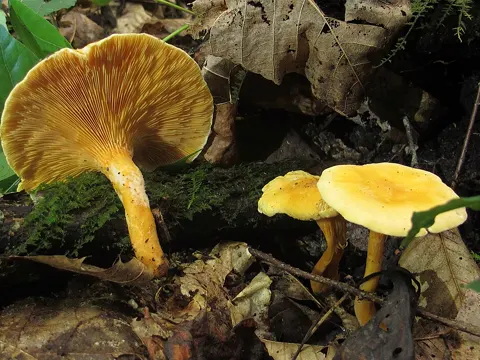
True gills. Repeatedly forking structures without the cross veins of chanterelles. MushroomExpert calls it soft and flimsy, First Nature gives tough stems. Most often in coniferous woods and on acid heathland.
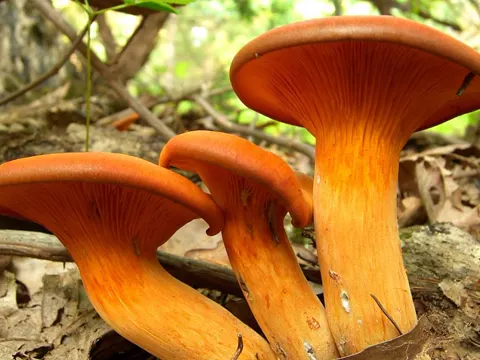
Bright orange to yellowish orange, usually in dense tufts from buried roots or stumps. True gills, and pale orange to orange flesh. Listed by the DGfM under the Omphalotus syndrome.
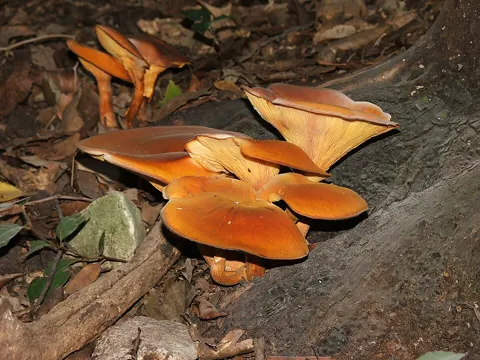
Bright orange to yellowish orange, usually in dense tufts, mainly under olive trees in southern Europe. Listed by the DGfM under the Omphalotus syndrome.
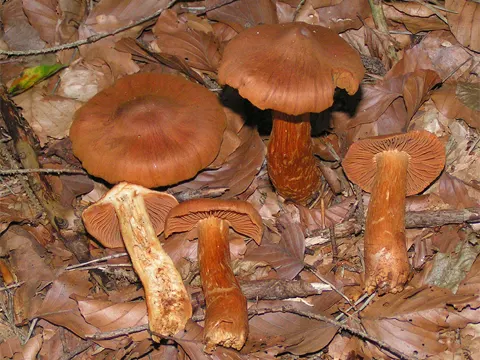
Tawny brown to orange cap, gills that turn rusty brown, with conifers on damp acid soil. Listed by the DGfM under the orellanus syndrome.
Photos are for orientation only: a photo alone is not enough to identify a species.
Collect only species you know with certainty. Wrinkled veins instead of true gills are a key feature, and show anything you are not certain of to a certified mushroom expert in person. Some lookalikes are poisonous, and the deadly webcap can cause kidney failure days to weeks later. If someone may have eaten a poisonous mushroom, get help even without symptoms: emergency services for severe symptoms (112 in Germany), otherwise a poison centre, for example Berlin 030 192 40. In the UK, call 999 or go to A&E, or call NHS 111 if you are not sure it was harmful. In the US, call 1-800-222-1222.
First Nature describes a usually funnel shaped, light yellow to deep egg yolk yellow cap up to 10 cm across with a wavy margin, and wrinkled veins rather than gills on the underside.
The Woodland Trust says mainly in broadleaved woods, but also under conifers. First Nature adds that they prefer acid soils.
Forage gives a typical window of June to November in the northern hemisphere, with a peak from June to September. First Nature gives June to October for Britain and Ireland, even into November in mild autumns.
MushroomExpert says the false chanterelle has true gills and is soft and flimsy, while chanterelles have false gills and are hard fleshed and sturdy. First Nature adds that the false chanterelle lacks the cross veins found in chanterelles.
The Federal Species Protection Ordinance allows small quantities for your own needs. The Federal Nature Conservation Act allows taking them only where no access ban applies. The DGfM gives a guide figure of about 1 to 2 kg per collector per day.
Forage shows you the species in your region and pings you when the season starts.


All information without guarantee. This text is orientation on season and habitat, not an identification guide, and it makes no claim about whether any specific plant or mushroom is edible. Many species have toxic, some deadly, lookalikes. Never eat or use anything that has not been identified with certainty by an expert, such as a qualified mushroom inspector. We accept no liability for any harm arising from the use of this information. If you suspect poisoning, call your local poison control center or emergency services right away. Mind conservation law and property rights.
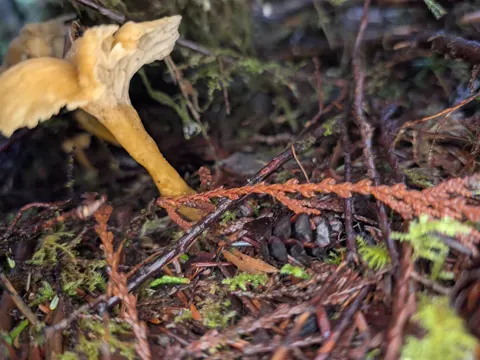 Trumpet chanterelleCraterellus tubaeformis